
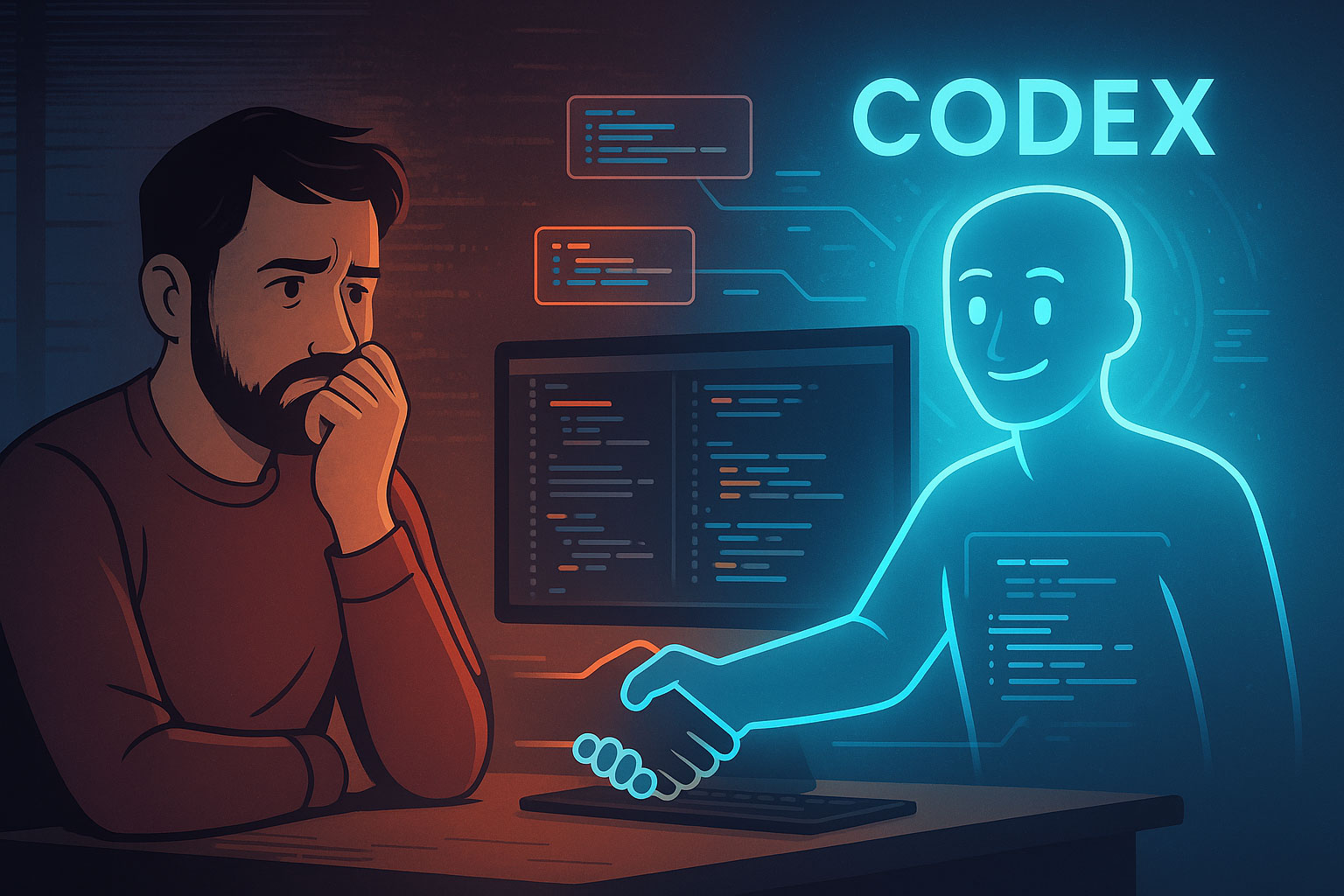
Codex and the Future of Developers: Ally or Threat?
As a full-stack developer, the first time I
integrated OpenAI Codex into my workflow, I knew something had changed.
Coding tasks that used to take me hours or days were now solved in minutes just
by giving the right instructions to this artificial intelligence. It seems like
magic, but it's a reality within reach of any programmer with the right tool.
However, this technological revolution comes with unsettling questions: Should
we be worried about the future of our profession? Is Codex the end of
programmers as we know them, or a new ally that will enhance our abilities?
AI Sounds Alarms... But Also Offers an Ally
It's no secret that advances in artificial
intelligence have sounded alarms in the developer community. Increasingly
sophisticated tools – like OpenAI Codex or ChatGPT – are already capable
of performing programming tasks quickly and accurately, from generating
complete websites to validating code and proposing improvements, all without
specialized human intervention. Unlike past technological revolutions
(which primarily affected manual jobs), this time the perceived threat reaches
highly skilled jobs: platforms like Codex can understand instructions in
natural language, generate functional code, and even correct errors on their
own, raising the dilemma of whether programmers will be replaced or
will find new ways to adapt.
Fortunately, many experts and industry leaders suggest that the key is to change perspective: see AI as an ally, not an enemy. Instead of displacing us, these tools can automate routine and tedious tasks, freeing us to concentrate on the more complex and creative aspects of software development. Adaptation and continuous learning will be fundamental to maintaining competitiveness in a rapidly evolving market. In other words, Codex isn't coming to take your job, but to change the nature of it. Now your role becomes more of a supervisor and architect who writes code, reviewing and guiding your AI "assistant" to ensure it follows best practices. In fact, OpenAI itself presents Codex as "your new ally in software development", conceived to work alongside you and boost your productivity, not to compete with you.
What is OpenAI Codex and how does it work?
To understand the impact, let's first
clarify what Codex is. OpenAI Codex is an advanced artificial
intelligence model trained to translate natural language into programming
code. It is a specialized descendant of GPT-3, specifically fine-tuned for
software tasks, and is in fact the engine behind GitHub Copilot – the popular
code autocompletion tool integrated into editors like VS Code. OpenAI trained
Codex with a gigantic knowledge base: about 159 GB of code (primarily
Python) from 54 million public GitHub repositories. Thanks to this, Codex
masters more than a dozen programming languages (including Go, JavaScript, PHP,
Ruby, Swift, TypeScript, among others), although its strong point is Python.
Originally, Codex was offered via API and
then powered tools like Copilot to suggest lines of code while we program. What
changed recently? In 2025, OpenAI launched a much more powerful version
integrated into ChatGPT: a cloud-based programming agent capable of
handling multiple tasks in parallel. It's no longer just about autocompleting a
line, but about assigning it complete objectives. For example, today you can
ask Codex: "Generate a backend function that calculates product
recommendations" or "Find and fix the bug introduced
in the last commit," and Codex will take that request and work
autonomously. Each task runs in an isolated environment in the cloud, with
access to your repository, where the AI can read and edit files, run tests,
run linters and more. Depending on the complexity, the task
can take from 1 to 30 minutes, and when finished, Codex commits the
changes in that virtual environment, attaching evidence of what it did (console
logs, test results, etc.) so you can review everything step by step.
Codex interface is integrated into
ChatGPT: The developer describes in natural
language what they need (for example, "implement dark mode in the
application"), and Codex executes that task in the background, showing
code diffs with the changes made. Each task is isolated in a sandbox with the
repository, and upon completion we can review the generated commitment,
request adjustments, or merge the changes into the real project.*
In practice, using Codex feels like
delegating work to a tireless programming assistant. We can interact with it
via text (prompts) either from the ChatGPT interface, a specialized CLI
or even integrate it into the IDE with extensions. For example, OpenAI offers Codex
CLI and extensions for VS Code or other tools, so you can ask Codex
for a new functionality directly from your editor. Codex navigates through your
code, inserts the necessary modifications, and runs automated test scripts
automatically. All this happens in the background "in the cloud" so
you can continue with your normal workflow. Upon completing the task, you will
have a result (generated or modified code) that you decide whether to
approve, edit, or discard, always maintaining final control. This
interaction cycle makes Codex behave almost like another member of the team:
one that works fast, doesn't get tired, and always follows your instructions to
the letter.
Advantages of Using Codex in Software Development
What does a developer or a company gain by
incorporating Codex into their projects? Below, we explore some of the main
advantages:
- Drastic Productivity Increase: Codex
can handle repetitive or tedious tasks in a fraction of the time. In my
experience, sprints that took several days are reduced to a matter of
hours or minutes thanks to effective delegation. Some developers report
that they are completing their work at 2x or 3x their usual speed
thanks to Codex. This means faster deliveries and fewer
all-nighters before deadlines.
- Focus on Creativity and Complexity: By
letting the AI handle the "heavy lifting" (scaffolding,
boilerplate, setting up basic structures), the human developer can
concentrate on the more strategic and creative parts. OpenAI itself
emphasizes that Codex was conceived to make human programming faster, not
to replace it, addressing especially the "less fun" portion of
programming. Instead of fighting with syntax or writing repetitive
code, you can dedicate more time to architecture design, optimization, and
innovative business solutions.
- Delegation and Parallel Work: Codex works asynchronously,
allowing something unprecedented: multiplying your hands. You can assign
it a list of tasks (for example, "Implement the
authentication module, create 5 test cases, and document the API")
and Codex will execute them in the background, possibly in
parallel, while you take care of other things. It's like having a team of
developers working 24/7 for you, processing multiple assignments at once.
This ability to scale development without increasing human staff can be a
game-changer for time-pressed projects.
- Quality Improvement and Bug Reduction: Used correctly, Codex
can help improve code quality. On one hand, it suggests code that
follows common patterns (based on thousands of examples), and on
the other hand, it includes automated code review functions. In fact, the
most recent version (GPT-5 Codex) includes a powerful review capability
that can detect critical bugs before they are integrated into the
main code. Likewise, by being able to automatically run unit
tests, Codex tends to iterate until the tests pass, resulting in fewer
regressions. For companies, this means fewer errors in production and a
more robust development cycle.
- Accelerated Learning and Developer Support: Having Codex is
like having a mentor or assistant always available. It can explain unclear
code sections, suggest alternative approaches, or even teach you how to
implement something in a language you don't master. For example, you can
ask it: "How do you make an HTTP call in Go?" and instantly get
a functional code snippet. This immediate support accelerates the
learning curve of developers and allows them to work above their
experience level (as long as they validate and understand the
suggestions). In corporate environments, a junior team with Codex – well
supervised by seniors – could perform like a much more experienced team.
- Faster Prototyping and Experimentation: Developers can also use
Codex to prototype functionalities or ideas in record time.
Because generating code with Codex is so fast, it's feasible to
test alternative implementations, do research _spikes, or validate
different approaches without investing days of manual coding. This drives
innovation within companies: it's easier to try a crazy idea when you know
you can have it working in a matter of minutes or hours.
In summary,
Codex empowers the programmer, allowing them to be faster and more ambitious.
As the co-founder of Fast.ai, Jeremy
Howard, said, “Codex is a way to write code without having to write so
much code,” achieving correct results or at least very close to the
goal in most cases.
That ability to
do the dirty work for us translates into happier developers and projects that
progress more smoothly.
Disadvantages, Risks, and Challenges of Codex
Not everything
is perfect in the world of AI-assisted programming. It is also important to
recognize the limitations and potential risks of relying on Codex, in
order to mitigate its effects:
- Potential Errors and Bad Practices: Although Codex was trained
with mountains of code, it is not
infallible. Sometimes it doesn't understand exactly what we ask
and generate an incorrect or misplaced solution. If we provide ambiguous
instructions, it can make wrong decisions. Likewise, Codex might follow
bad practice patterns if it learned low-quality code from the dataset.
Essentially, the AI does not distinguish on its own between an
optimal solution and a sloppy one; it only follows our
instructions and learned patterns. This means that a developer
without sufficient experience might accept faulty code believing it's
correct, introducing subtle bugs or antipatterns into the codebase without
realizing it.
- Dependency and Skill Stagnation: There
is a risk that, for convenience, programmers delegate too much to the AI
and lose touch with the fundamentals of coding. If we blindly accept
everything Codex suggests, our own debugging, optimization, or even
logical thinking skills could atrophy over time. It is crucial to use
Codex as support, but to continue understanding the generated code and the
decisions made. Otherwise, we might find ourselves maintaining systems
that work without truly understanding them thoroughly,
which is a dangerous situation in the long term for any development team.
- Need for Expert Supervision: Related to the above, Codex cannot operate without human guidance.
OpenAI emphasizes that it remains essential to manually review and
validate all code produced by the AI before integrating it
into the project. In practice, using Codex is like directing an
extremely fast junior developer: you must monitor their commits, do code
review, and teach them what to correct. If the user does not have solid
development knowledge, they risk introducing failures because the AI will
literally do what it is asked, even applying wrong practices if they were
implied in the given instruction. In short, Codex magnifies both
your expertise and your oversights: with a good technical leader,
it produces high-level code; with little supervision, it can
amplify the mess.
- Security Risks and Code Quality: Several
studies have pointed out serious concerns regarding the quality of certain
fragments generated by AI. For example, researchers from New York
University found that approximately 40% of the code that Github Copilot
(based on Codex) suggested for security-critical situations contained vulnerabilities
or exploitable defects. This shows that, without rigorous
control, we could inadvertently incorporate security breaches into our
applications. Furthermore, Codex learns from public code that may include
biases or errors; if there are common unsafe practices in the training
data, the AI could repeat them. There has even been mention of the
possibility that malicious actors "poison" the public dataset
with seemingly useful but malicious code, to deceive models like Codex.
All this reinforces the importance of not letting our guard down:
the final say on security must still belong to a human developer
with good judgment.
- Ethical and Legal Issues: The
use of generative AI in programming also raises legal questions. Since
Codex was trained with public repositories, there is debate about whether
the code it produces can be considered derived from that material and
whether it could violate free software licenses. The Free
Software Foundation, for example, has expressed concern that generated
snippets could infringe terms of licenses like the GPL. Furthermore, there
is the issue of authorship: if an AI generates a substantial portion of
code, who is the author legally speaking? These questions still don't have
clear answers in 2025, and companies must be cautious, especially if they
work with open source, to ensure they comply with the corresponding
licenses and attributions.
- Labor Impact and Professional Uncertainty: Finally, we cannot ignore the elephant in the
room: the anxiety that tools like Codex will reduce the demand
for certain jobs. If a task that previously required a team of three
developers can now be done by a single developer supported by
Codex, it's natural to wonder what will happen to those other two positions.
In the short term, we might see less need for very junior profiles
for simple tasks, since an experienced developer with Codex can
handle them. However, this does not mean mass unemployment for
programmers, but a transformation of roles. Programmers will have
to reinvent themselves to remain relevant in the new digital
era. Routine "code-crunching" tasks may decrease, but
the importance of roles focused on architecture, requirements analysis,
quality supervision, client interaction, and training domain-specific AI
models will grow. In short, demand will shift towards developers who know
how to collaborate with AI instead of competing against it.
Real-World Use Cases of Codex
To ground all of
the above, let's look at some concrete use cases where Codex shines in the
day-to-day of software development:
- Code Generation from Descriptions: This
is the most basic but impressive use. A developer can simply describe in
natural language what they need and Codex produces the corresponding code.
For example: "Create a function in Python that reads a CSV, filters
the rows by date, and calculates basic statistics". In seconds, the
AI returns a block of code that performs that task. This greatly
accelerates the implementation of new features, since you start
from an idea in Spanish/English and get an initial implementation in the
language of your choice.
- Intelligent Autocompletion in the IDE (Copilot style): While you write code, Codex (through GitHub Copilot or
other integrations) suggests the continuation. It's useful for quickly
writing known patterns, like loops, SQL queries, data structures, etc. For
example, you start writing a function and automatically the proposal for
the entire function body appears based on the context. Many developers
report that, thanks to this, they write less code "by hand" and
dedicate more time to fine-tuning the logic. It's like having a
silent pair programmer whispering to you how to continue
the line of code.
- Debugging and Bug Fixing: Codex
can act as a debugging assistant. You can give it an error message or
describe a bug, and ask for help to fix it. It can even run in agent mode:
when it finds failing unit tests, it tries to correct the code until all
tests pass. Imagine detecting an error that breaks the build; in instead
of spending hours looking for it, you tell Codex "fix what's causing
test X to fail" and the AI locates the problematic section and
suggests a patch. This not only saves time but also shows you
where the failure was, serving as a learning experience.
- Automated Code Review: One of the most recent functionalities
is using Codex for code review. You can ask the AI to analyze a
pull request and highlight potential problems or improvements.
There's even integration with GitHub so that when you mention @codex in a
PR, it automatically starts a cloud-based review. Codex will review the
proposed changes, run tests if available, and issue a report: for example,
"The PR passes all tests, but function X has high cyclomatic
complexity, it could be refactored". Then the human team decides
whether to accept the PR or apply the suggestions. This greatly speeds up
the review process, especially in large teams where pull requests can take
days to be evaluated by a busy developer.
- Refactoring and Legacy Code Improvement: Another valuable use
case is taking existing code and asking Codex to improve or
modernize it. For example: "Refactor this class component to React
hooks" or "Optimize this sorting algorithm". Codex will
analyze the given code and generate a new version following the
instructions (of course, you always have to verify that the output is
correct and efficient). This kind of help is great for dealing with old
codebases or for applying best practices in a more automated way.
Similarly, it can be used for migrations: "Convert this code
from Python 2 to Python 3" or "Translate this Ruby script to
JavaScript". Codex's multilingual capability makes it easy to move
logic between platforms quickly.
- Integration with External Services and APIs: Codex not only
understands our repositories, it can also interact with external APIs and
tools by writing the necessary code. OpenAI demonstrated in its tests that
Codex could, for example, automatically generate integrations with
services like Spotify, Mailchimp, or Google Calendar, writing the
necessary code to consume those APIs. This means that if you ask it,
"connect our application to the Twitter API and post a tweet
when the server throws a 500 error", Codex can assemble the
corresponding snippet (using the appropriate authentication,
calling the Twitter endpoint, etc.). For a developer, this is a very fast
way to enable functionalities that would otherwise require reading
documentation and writing integration boilerplate.
- Documentation and Education Assistant: Finally, Codex can be
used as an oracle of code knowledge. Suppose you arrive at a new
project and struggle to understand a certain module; you can ask
Codex in natural language "What does the function
[processPayment()] do in this project?" and get a text
explanation. It can also help generate documentation
automatically: from a function without comments, ask "document
this function" and get a docstring or comment in Markdown
describing its behavior. While not always perfect, it's a useful
base that saves developers time in writing basic documentation. In
educational terms, programming students can use Codex to test examples,
get help with exercises (being careful not to cheat excessively!), or
understand how to solve a problem by seeing the code the AI generates.
These use cases
are already becoming commonplace in the most cutting-edge companies. We have
seen Codex create everything from simple web games to data science
graphs with a single instruction, demonstrating its versatility. The key is
for the human developer to discover how to ask the AI correctly (the art of
prompting) and then take charge of verifying and polishing the results to bring
them to production with confidence.
Conclusions: The Developer of the Future, Empowered by AI
Far from
decreeing the disappearance of programmers, OpenAI Codex aims to transform us
into something new: AI-augmented developers. In this scenario, creativity,
judgment, and human supervision matter more than ever, while a large part of
the mechanical work can be automated. As developers, we will no longer just be
the ones who type each line, but the orchestrators who direct
powerful digital assistants to materialize solutions. OpenAI summarizes this
vision by describing Codex as a "teammate" that understands your
context, works alongside you, and reliably takes on heavy lifting.
Should we then
worry about our future? If we continue doing things exactly the same as
before, perhaps yes, because the world of technology advances relentlessly. But
if we embrace tools like Codex, incorporate them into our toolbox, and
raise our level to focus on what machines still cannot do (understanding human
problems in depth, making high-level decisions, innovating from experience),
then there is nothing to fear. On the contrary, we have much to gain. A
developer equipped with AI can be unstoppable: imagine the execution
speed of the machine combined with the vision and experience of the
human. Companies that adopt this symbiosis will be more agile and
efficient, and the professionals who master it will become highly sought after.
In conclusion,
Codex is not the enemy of programmers, but a powerful new ally. Like any ally,
it comes with challenges: you must know its limitations, guide it, and maintain
ethics and quality. But those willing to learn to collaborate with artificial
intelligence will discover that the future of programming is not a minefield of
unemployment, but a fertile ground of expanded opportunities. The question is
no longer whether AI will replace the developer, but how far the developer
who leverages AI will go. And, from what we have seen so far, the
answer is: very far.
References
Chen, M., Tworek, J., Jun, H., Yuan, Q.,
de Oliveira Pinto, H. P., Kaplan, J., … Zaremba, W. (2021). Evaluating large
language models trained on code. arXiv. https://arxiv.org/abs/2107.03374
GitHub. (n.d.). About GitHub Copilot.
GitHub Docs. https://docs.github.com/
OpenAI. (2021, August). Introducing
OpenAI Codex. OpenAI Blog. https://openai.com/blog
Free Software Foundation. (2021). Questions
about GitHub Copilot and free software. Free Software Foundation.
https://www.fsf.org/